Blog · Energy and focus
How do I avoid the 3pm slump at work?
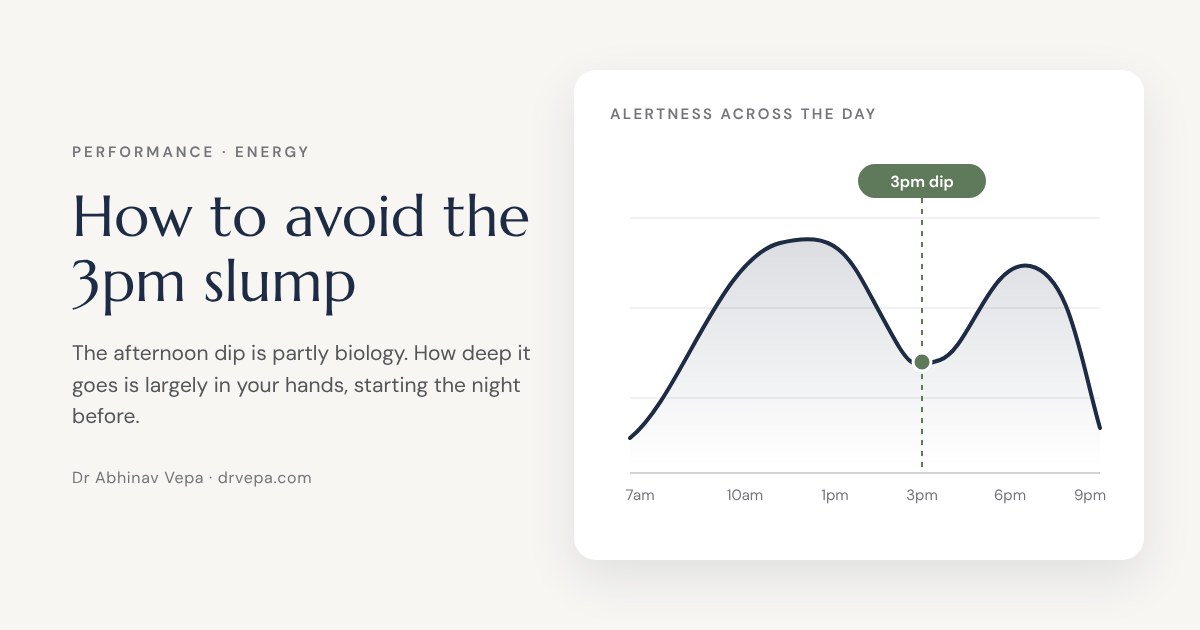
- The afternoon dip is natural, but sleep and lunch shape how deep it goes
- Have your last coffee about 9 hours before bed
- Five-minute walks every hour beat one long break for afternoon energy
Around mid-afternoon, focus thins, emails take twice as long and the biscuit tin starts calling. You are not imagining it, and it is not a lack of willpower. Here is what the evidence says you can change, from last night’s sleep to your afternoon coffee.
Why does the afternoon slump happen?
Part of it is built into human biology. Sleep pressure rises in the early to mid-afternoon, and the dip appears even when people skip lunch and cannot see a clock1. A large, carbohydrate-heavy lunch makes it deeper1. You cannot remove the dip entirely, but you can make it much shallower.
1. Last night’s sleep
In a landmark laboratory study, adults limited to 6 hours a night for two weeks performed as poorly on attention tests as people kept awake for up to two nights in a row. Yet they rated themselves as only slightly sleepy2. That is the trap for busy professionals: you get used to feeling tired, but your performance does not recover.
- Give yourself at least 7 hours in bed, and keep your wake-up time roughly the same, weekends included.
- If you snore loudly, wake unrefreshed, or doze in meetings despite enough time in bed, speak to your GP. Sleep apnoea is common in men and very treatable.
2. Your morning routine
- Get light early. Daylight is a strong signal to your body clock. A Cochrane review found brighter, cooler-white workplace lighting may improve alertness, although the evidence is weak3. In a small trial, bright light in the early afternoon also eased sleepiness and low mood4. Walk part of your commute, or take your first call outside.
- Move before you sit. In a randomised trial, a 30-minute morning walk raised energy and vigour across a day of desk work5.
3. Breakfast and lunch
- Breakfast: the type of carbohydrate seems to matter less than many people think. In a crossover trial, a low-glycaemic breakfast showed only a small trend towards better memory and attention6. I suggest building it around protein and fibre, such as eggs, Greek yoghurt with nuts and berries, or porridge, mainly for steady appetite.
- Lunch: this is your biggest lever. In a randomised trial, a higher-fat lunch built around almonds reduced the post-lunch drop in memory by more than half, compared with a high-carbohydrate lunch7. Aim for protein, vegetables and healthy fats, with a modest portion of starch, and stop before you feel full.
4. Caffeine: timing is everything
A 2023 meta-analysis of 24 studies found that caffeine cut total sleep by about 45 minutes. To avoid this, a regular coffee should be drunk at least 8.8 hours before bed, and a pre-workout drink at least 13 hours before8. An earlier trial showed that a large dose even 6 hours before bed disrupted sleep9.
So if you go to bed at 11pm, your last coffee is around 2pm. A 3pm espresso buys an hour of focus at the cost of tomorrow afternoon, and the cycle repeats. You may have heard that delaying your first coffee of the day helps. I have not found good trial evidence for that. What clearly matters is when you have your last one.
5. Move little and often
In the same randomised trial, six 5-minute walks spread across the day did something a single 30-minute walk did not: they improved mood, reduced fatigue and cut food cravings by late afternoon5. A follow-up study found the same drop in fatigue10.
- Take walking one-to-ones, use the stairs, and set a reminder to stand up every hour.
- At 2.30pm, swap the biscuit for a 5-minute walk outside. You get movement and daylight together.
6. Drink enough water
Losing just over 1% of your body weight in fluid, around 750 ml for a 75 kg man after a sweaty commute or workout, increased fatigue and reduced concentration in trials of men11 and women12. Keep a bottle on your desk, especially after exercise.
7. If you can, take a short nap
After a short night, a 10-minute nap at 3pm improved alertness straight away, with benefits lasting over 2 hours. A 30-minute nap left people groggy at first13. A meta-analysis found that daytime naps improved thinking, especially alertness, although most studies were done in laboratories14.
Keep it to 10 to 20 minutes, ideally before 3pm, with an alarm. No quiet room at work? A brisk walk outdoors is the next best thing.
Your plan for tomorrow
- Same wake time, and at least 7 hours in bed.
- Daylight within an hour of waking.
- A breakfast with protein and fibre.
- A lunch built on protein, vegetables and healthy fats.
- Last coffee about 9 hours before bed.
- A 5-minute walk every hour, and water on your desk.
Give it two weeks before you judge it. If good sleep tonight is the hard part, you may find my guide to the best foods for sleep useful.
If you feel exhausted most days despite good habits, please see your GP. Causes such as anaemia, an underactive thyroid, diabetes, low mood or sleep apnoea are worth checking.
References
- Monk TH. Clin Sports Med 2005
- Van Dongen HPA et al. Sleep 2003
- Pachito DV et al. Cochrane Database Syst Rev 2018
- Zhou Y et al. Front Public Health 2021
- Bergouignan A et al. Int J Behav Nutr Phys Act 2016
- Sanchez-Aguadero N et al. Nutr Neurosci 2020
- Dhillon J et al. Br J Nutr 2017
- Gardiner C et al. Sleep Med Rev 2023
- Drake C et al. J Clin Sleep Med 2013
- De Jong NP et al. Int J Environ Res Public Health 2018
- Ganio MS et al. Br J Nutr 2011
- Armstrong LE et al. J Nutr 2012
- Brooks A, Lack L. Sleep 2006
- Dutheil F et al. Int J Environ Res Public Health 2021
For general education, not personal medical advice. Individual results vary.